

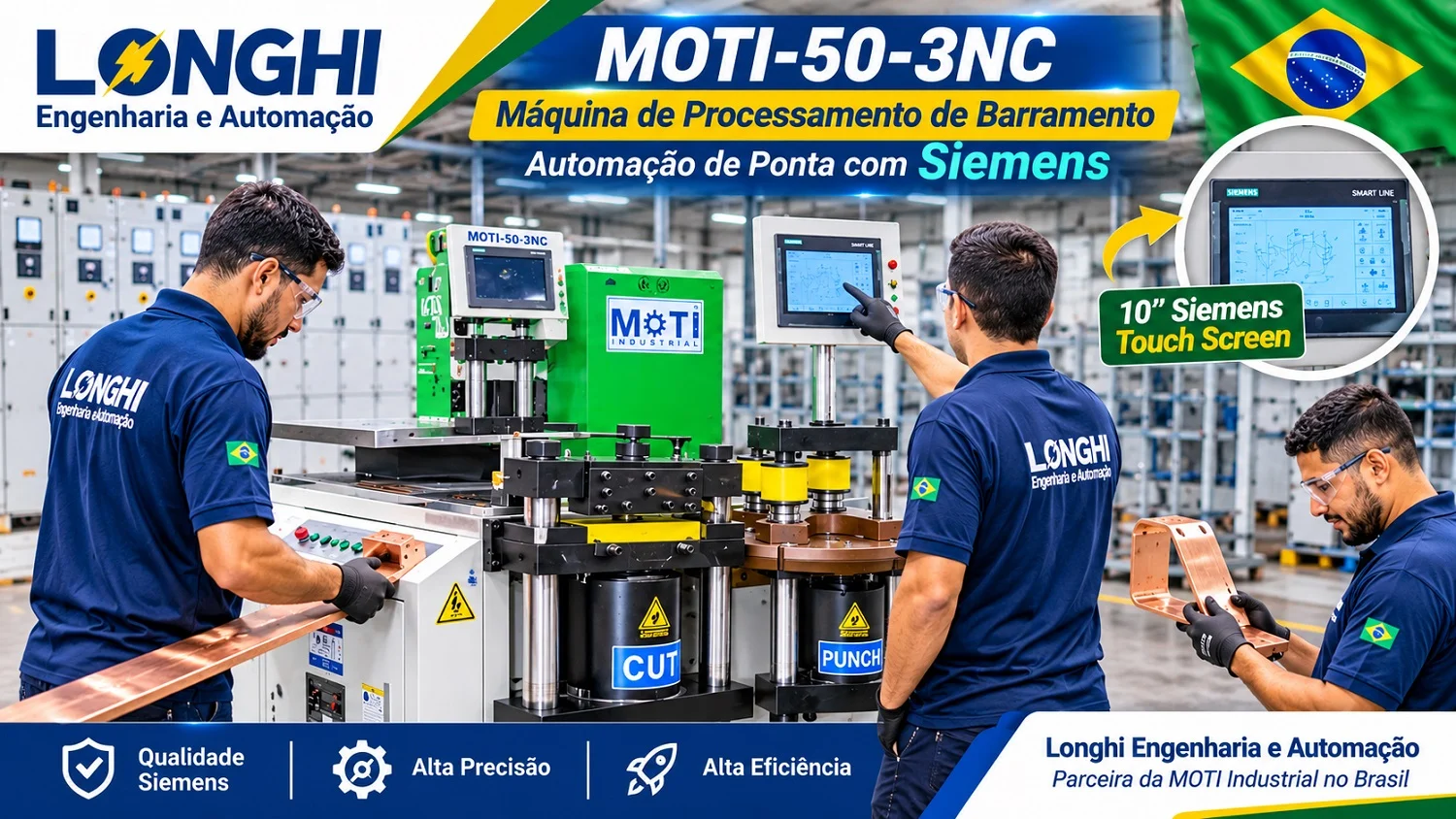
What a Brazilian panel builder tested before signing — and the three tooling questions that decide how a busbar machine performs in its second year.
A MOTI-50-3NC CNC 3-in-1 busbar processing machine has left MOTI INDUSTRIAL’s works in Jinan for Caxias do Sul, in the Brazilian state of Rio Grande do Sul. The buyer is Longhi Engenharia e Automação, an electrical engineering and industrial automation company that has been building panels since 1975.
The order did not come from a catalogue. It came from a test. At FEIMEC 2026 in São Paulo, Longhi’s engineer punched, sheared and bent copper bar on the machine himself before the purchase order was raised — and then asked questions that most buyers only think of after delivery.
This article covers what the machine is, how it is configured, and the part of a busbar machine purchase that no specification sheet shows: the control hardware inside the cabinet, and the steel in the tooling.
Key takeaways
- Capacity: copper and aluminium busbar up to 16 mm thick × 250 mm wide, punching Ø4.3–Ø34 mm.
- Configuration: shearing, punching and bending on one base, driven by three independent motor-pump groups — three operators can work at once without interference.
- Control: 10-inch Siemens touchscreen, Siemens electrical package, and an icon-based interface developed in-house so the machine can be operated without reading English.
- Tooling: Cr12MoV punching dies and shearing blades; 45# carbon steel bending dies with full-surface hardening and a blasted, uncoated finish.
- Verification: five checks any buyer can run before payment — listed in section 4.
- MOTI-50-3NC at a glance
- The order started at FEIMEC 2026, São Paulo
- What a 16 × 250 mm 3-in-1 machine actually does
- The Siemens control system — and why “Siemens” alone means nothing
- Bending dies: three things you can check before you buy
- Punching dies: where the real cost hides
- Shearing blades: the part you cannot see
- Why this configuration suits a panel shop like Longhi
- Frequently asked questions
1. MOTI-50-3NC at a glance
| 功能 | MOTI-50-3NC |
|---|---|
| Punching force | 500 kN |
| Punch diameter range | Ø4.3 – Ø34 mm |
| Max. busbar thickness | 16 毫米 |
| Max. busbar width | 250 毫米 |
| Shearing capacity | 16 mm × 250 mm |
| Vertical bending force | 500 kN |
| Horizontal bending | 120 mm × 12 mm, up to 90° |
| Bending accuracy / repeatability | ±1° / ±0.3° |
| Dimensions (L × W × H) | 1950 × 1560 × 1420 mm |
| Motor power | 3 × 5.5 kW |
| 重量 | 1750 kg |

2. The order started at FEIMEC 2026, São Paulo
Longhi’s team met MOTI INDUSTRIAL at FEIMEC 2026 in São Paulo. The engineer who accompanied the visit did not want a video, a brochure or a reference list. He wanted to run the machine.
What he tested
Over the demonstration he punched holes in copper bar, sheared a length to size, and bent a section to an angle — then re-checked the result. He asked how the angle was entered, how the punch centre was located, what happened to the ram when the foot pedal was released mid-stroke, and which parts would need replacing first.
That sequence matters. A machine can look convincing in a showroom and still behave differently when a shop runs it eight hours a day. Ten minutes on the pedals tells you more about a busbar machine than a page of specifications: whether the blade bites cleanly or folds the edge, whether the ram returns predictably, whether the operator has to fight the machine to hold a dimension.
Why the test settled it
After the demonstration the customer placed the order. That is the only kind of demonstration MOTI INDUSTRIAL considers valid — a buyer working the machine, not watching it.
3. What a 16 × 250 mm 3-in-1 machine actually does
The MOTI-50-3NC processes copper and aluminium busbar up to 16 mm thick and 250 mm wide, which is the working range of most low-voltage switchboard and panel builders — including the widths used in Brazilian panel construction.
Three stations on one base, three motor-pump groups underneath
Shearing, punching and bending sit side by side on a double-deck work table. What separates this machine from a single-station press is the drive: three independent motors and three hydraulic pumps, one per station.
The consequence is practical rather than technical. One operator can shear a bar while a second punches a different part and a third bends a third — and none of them waits for the others. On a machine with a shared pump, every operation queues behind the one in progress.
MOTI INDUSTRIAL measures the effect against conventional single-function processing at 5 to 8 times the throughput and roughly 60% better precision, because a bar cut, punched and bent without being re-clamped keeps its reference edges.
Where each operation happens
- Shearing: double-column shear with flat blades — a clean cut with no waste slug and no collapsed edge, which means no secondary filing before assembly.
- Punching: six-station rotary die plate, so six die sizes stay loaded and a change of hole size does not mean a change of tooling. Hole centres are located by laser pointer, coordinate axis or positioning pin.
- Bending: closed-frame bending head with interchangeable dies for vertical (L, Z), horizontal (U), embossing, twisting and chamfering work; angle and thickness are entered on screen and the ram returns automatically.

4. The Siemens control system — and why “Siemens” alone means nothing
A 10-inch screen with an interface built in-house
The machine runs a 10-inch Siemens touchscreen with Siemens electrical components throughout the cabinet. On top of the Siemens platform, MOTI INDUSTRIAL engineers have written their own operating layer — one that replaces text buttons with icons, in the same way a modern car replaces labelled switches with symbols on a central display.
The reasoning is not cosmetic. A busbar machine sold into Brazil, Russia, the Gulf or Southeast Asia ends up operated by people who may not read English fluently. An icon for “bend”, “punch” and “shear” is understood on the first shift; a text menu is not.

The counterfeit component problem
Most busbar machines on the international market are not built by the company selling them. They are bought from an OEM and rebadged, and in that chain the electrical package is where cost is most often removed. MOTI INDUSTRIAL’s own assessment of the low-price segment: more than 90% of the PLCs in those machines are counterfeit or substandard Siemens units, with relays and thermal relays of the same quality — and motors wound with the minimum possible copper.
None of this is visible from the outside. The cabinet is closed, the paint is new, and the machine runs perfectly for the first months. The failure shows up later, as nuisance trips, unexplained stops, a burned coil, or a motor that runs hot under continuous load.
Five checks you can run before you pay
- Ask for a photograph of the open cabinet, with the PLC model plate legible. A supplier who will not send one has answered the question.
- Match the PLC model number against Siemens’ own catalogue for the series quoted. Counterfeits often carry a model number that does not exist, or exists in a different form factor.
- Count the relays and check the labelling. Labelled KA numbers, printed ferrules on every core, and numbered terminal rails are the signature of a cabinet that was engineered rather than assembled.
- Weigh the motor question. A motor built with less copper weighs less and runs hotter. Ask for the nameplate rating and compare it with the claimed power.
- Ask for the pressure-test record. A machine that has held pressure for a full cycle before shipment is a machine that was actually tested, not just run for a photo.
These five checks cost nothing and eliminate most of the risk in a busbar machine purchase. They apply to any brand, including ours — which is why we publish cabinet photographs and keep the wiring numbered.
5. Bending dies: three things you can check before you buy
Material: 45# carbon steel, or cast iron
Bending dies should be machined from 45-grade carbon steel. Some suppliers substitute cast iron, which machines faster and costs less but does not carry the same load. The difference is not visible in a photograph; it is visible in the failure mode, usually a cracked female die after a year of production.
Heat treatment: the whole working surface, or one third of it
Dies are hardened — by heat treatment or high-frequency induction — to resist wear at the working face. In MOTI INDUSTRIAL’s assessment of the market, more than 95% of suppliers harden only about one-third of the working surface. The die looks identical, feels identical on the outside, and cracks earlier where the hardness stops.
Ask a supplier how much of the working surface is hardened, and whether they will put it in writing.
Surface finish: black hides, silver-white shows
If a set of bending tools arrives entirely black, the surfaces have not been ground or polished — the black oxide is there to conceal tool marks and imperfections underneath. MOTI INDUSTRIAL’s bending tools are sandblasted to a silver-white finish, so the grain of the material and the quality of the machining are both visible before the tool ever touches a busbar.
A finish is not a performance specification. But a supplier willing to show the surface is usually a supplier willing to show the steel.
6. Punching dies: where the real cost hides
Cr12MoV, or G15 with a Cr12MoV label
Almost every punching die on the market is described as Cr12MoV tool steel. In practice a large share are G15, which costs less than one-fifth as much and lacks the hardness to survive production punching. The consequence is a die that breaks or mushrooms within roughly three months and has to be reordered — repeatedly.
That is the business model behind a low machine price: sell the machine at cost, then earn on replacement dies for the next five years. The buyer sees a cheap machine on the invoice and an expensive machine in the accounts.
Check the core
You do not need a metallurgy lab to make a first judgement. Look at the core of the die: a genuine tool-steel die is machined and finished through the body, not just at the cutting edge, and the internal surfaces show it. Ask for the material certificate and a hardness report. A supplier who cannot produce either is telling you something.
Die size should scale with the machine
Punching force is not the only limit on hole size — die strength is. A 50-ton machine punching 16 mm bar needs a larger-diameter die body than a 30-ton machine punching 12 mm bar, because the die has to survive the load without splitting.
MOTI INDUSTRIAL builds separate die sets per model: the dies for the 503 and 803 series are visibly larger in outside dimension than those for the 303 series. A significant share of the market does not do this — the same small die, designed for a 30-ton machine, is sold across 30-, 50- and 80-ton models. It fits, it punches, and it fails early.
When you compare quotations, compare the die dimensions as well as the die price.

7. Shearing blades: the part you cannot see
MOTI INDUSTRIAL’s shearing blades are made from Cr12MoV die steel, a material most busbar machine suppliers do not use. Ask them and they will say they do — the difficulty is that the blade sits inside the shearing unit, and you cannot see it in its entirety from outside the machine.
That is precisely why the blade is the easiest place to remove cost and the hardest place to detect it. Two machines can look the same on the floor and cut very differently in year three: one still producing a clean, square edge, the other crushing the bar and needing a file at every cut.
The practical answer is documentation. Request the blade material and hardness before shipment, and keep the certificate with the machine.
8. Why this configuration suits a panel shop like Longhi
Longhi Engenharia e Automação was founded in 1975 in Caxias do Sul and has since delivered more than 6,000 projects and supplied over 8,000 electrical panels — command panels, motor control centres, low-voltage main switchboards, power factor correction boards and refrigeration control panels — to refrigeration plants, machine builders and industrial clients across Brazil.
The workflow of a panel shop is not the workflow of a machine shop
A panel builder does not process busbar in long production runs. It processes short runs, every day, with dimensions that change from panel to panel: a few bars for a control panel in the morning, a set of main busbars for a switchboard in the afternoon. Setup time dominates. Re-clamping dominates. Waiting for another operator to finish at the shared station dominates.
That is the argument for three independent stations rather than one large shared one — and for a machine whose tooling is already loaded and whose dimensions are entered rather than measured.
The second-year test
Longhi will not judge this machine on the day it is unloaded. They will judge it in the second year, when the questions are: does the blade still cut a clean edge, do the bending dies still hold their angle, do the punching dies still hold tolerance after tens of thousands of holes.
A purchase price is paid once. Tooling is paid for again and again. That single sentence explains every material decision in sections 5 to 7 — why Cr12MoV rather than G15, why the full working surface is hardened, why the tools are blasted rather than blackened.
From Jinan to Caxias do Sul
The distance is roughly 18,000 kilometres. The machine will spend the next decade proving that the distance did not matter — which is the only useful measure of an export purchase.
9. Frequently asked questions
What is the maximum busbar size the MOTI-50-3NC can process?
Copper or aluminium busbar up to 16 mm thick and 250 mm wide, with punching from Ø4.3 mm to Ø34 mm. Vertical bending force is 500 kN; horizontal bending covers 120 mm × 12 mm at up to 90°.
Can three operators use the machine at the same time?
Yes. Shearing, punching and bending each have their own motor and hydraulic pump, so the three stations run independently. One operator cutting does not stop another from punching, and none of the three waits for a shared pressure supply.
How can I confirm a busbar machine really uses Siemens components?
Ask for a photograph of the open cabinet with the PLC model plate readable, then cross-check the model number against Siemens’ catalogue. Look for labelled relays, printed ferrules and numbered terminal rails — counterfeit packages rarely carry all three.
Which material should busbar punching dies be made from?
Cr12MoV tool steel, with a material certificate and hardness report. G15 is often substituted because it costs less than one-fifth as much, but it lacks the hardness for production punching and typically fails within about three months.
Why are the dies for a 50-ton machine larger than those for a 30-ton machine?
Because die body strength, not just tonnage, limits the hole. Thicker busbar requires a larger-diameter die to survive the punching load without splitting. Suppliers who ship one small die across 30-, 50- and 80-ton models are trading die life for die price.
What should I inspect before a busbar machine ships?
Electrical point-to-point verification, a pressure test held over a full cycle, stroke and alignment checks, and a full function run on sample bar. Ask for the records, not just the finished photographs.
Conclusion
The MOTI-50-3NC shipped to Longhi Engenharia e Automação is a 16 × 250 mm machine with three independent stations, a Siemens control package and Cr12MoV tooling. None of that is unusual in a catalogue. What is unusual is that every one of those points can be verified before the machine is paid for — cabinet photographs, material certificates, hardness reports, pressure-test records.
If you are specifying a busbar machine for a panel shop, a switchgear manufacturer or a transformer builder, start with your busbar sizes and your daily volume, not with a price. The machine that fits your work will cost less over ten years than the machine that was cheap on the invoice.
Need a busbar machine sized to your panel shop?
Send us your busbar sizes, your daily output and the panel types you build. We will recommend the model, the tooling and the die sizes — and send the cabinet and tooling documentation with the quotation.