

Six questions that decide the purchase — the busbar you actually process, the bill of materials behind the paint, who repairs it at 2 a.m., and whether the supplier has already proven itself in your country.
A panel builder does not buy a busbar machine the way a machine shop buys a press brake. The machine is not the product — it is the thing that has to keep the product moving: switchgear, control panels, transformer connections, distribution boards, all of them due on the same date.
That changes what matters. Capacity is only the first question, and usually the easiest one to answer. The harder ones are about what happens in year three, and about who picks up the phone when a blade chips on a Thursday afternoon with a panel shipping on Sunday.
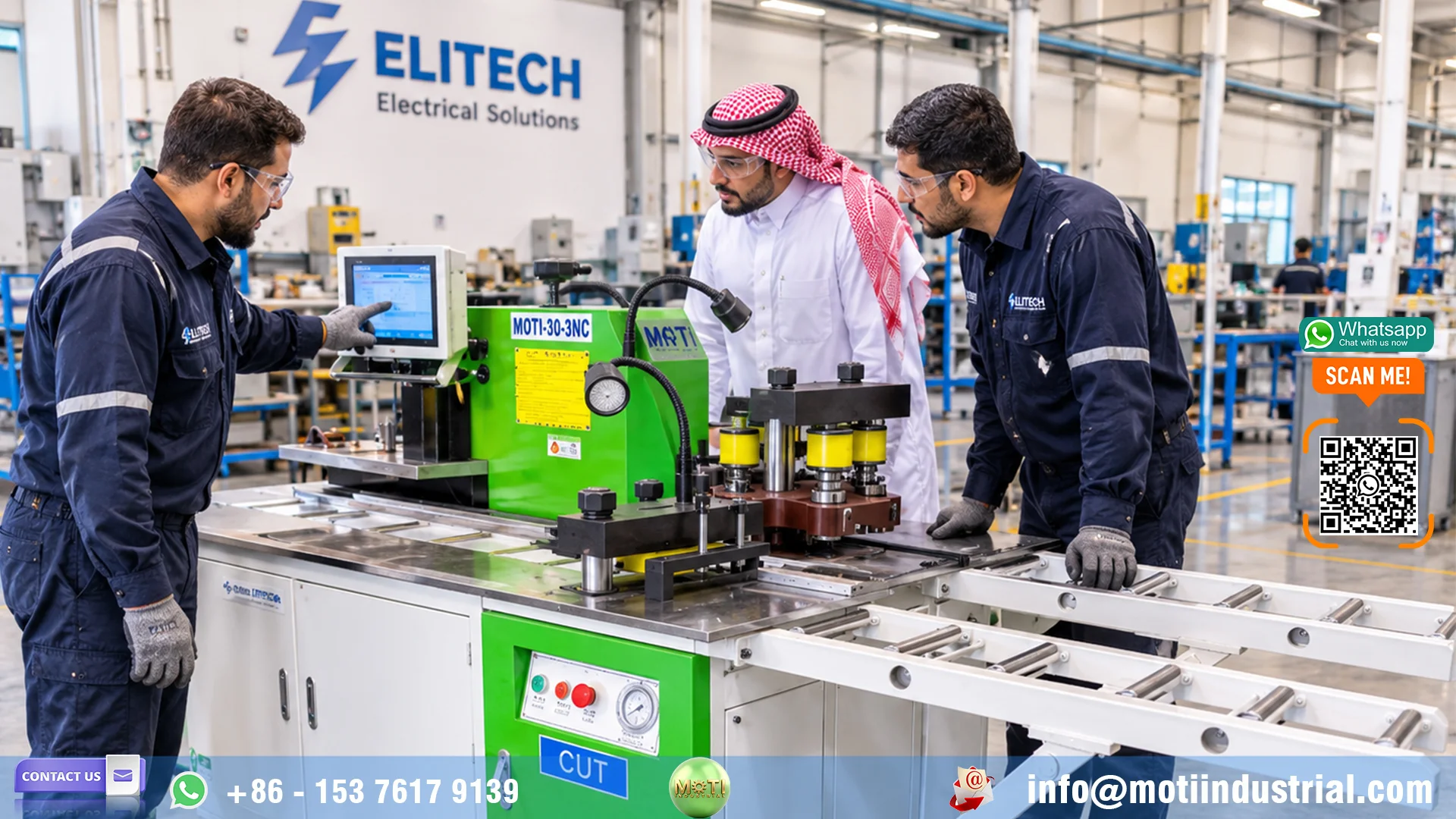
This month MOTI INDUSTRIAL shipped a MOTI-30-3NC MAX — a 12 mm × 200 mm CNC 3-in-1 busbar machine — to PAC (Power & Automation Control) in Lebanon. That order is a useful case study, because PAC did what a well-run switchgear manufacturer should do: they bought for the busbar they actually process, they added two portable tools for site work, and they asked for documentation before the container was sealed.
Technical Pararmeter of MOTI-30-3NC MAX
If you want to check more detailed information of the MOTI-30-3NCMAX, check the link below:
https://www.motiindustrial.com/product/BUSBAR_MACHINE/cnc_busbar_processing_machine_3_in_1_/872.html
The six questions, in short
- Sizing — buy for the largest bar you cut every week, not the largest you might see once.
- Bill of materials — electrical components, tooling steel and hydraulic build decide year-three cost.
- Tooling ownership — dies and blades are a recurring purchase, so price them before you sign.
- Service capability — a named engineer, a spare-parts list and a documented response, not “24/7 support”.
- Installed base — how many machines of this model run in your country, and can you call two owners?
- Local support — distance to a technician and whether consumables are held locally.
- Start with the busbar you actually process
- Quality is a bill of materials, not a claim
- Who owns the tooling — the real cost of ownership
- What “after-sales” actually means
- Has the manufacturer actually sold here?
- Local technical support is a logistics question
- What went into this Lebanon delivery
- The ten questions to send before you ask for a price
1. Start With the Busbar You Actually Process, Not the Busbar You Admire
The most common expensive mistake in this category is oversizing. A buyer sees a 16 × 250 mm machine, imagines a future project, and pays for capacity that sits unused for the next decade — in purchase price, in floor space, in oil volume, and in a slower ram on the thin bars they run every day.
The MOTI-30-3NC MAX is rated for 12 mm × 200 mm copper and aluminium. For most low-voltage switchgear and panel work, that covers the whole job:
| What you are processing | Typical range | Covered by 12 × 200 mm |
|---|---|---|
| LV main busbars in distribution panels | 5 × 40 to 10 × 120 mm | Yes |
| Incoming and outgoing connections in switchgear | 8 × 80 to 12 × 100 mm | Yes |
| Transformer LV connections and links | 10 × 100 to 12 × 120 mm | Yes |
| Earth bars, PEN bars, neutral bars | 4 × 20 to 8 × 60 mm | Yes |
| Busbar trunking taps and offsets | up to 12 × 160 mm | Yes (check tap width) |
Where it stops: heavy MV switchgear links, large transformer LV connections above 12 mm, and long busbar runs that need 250 mm width. If that is your recurring work rather than an occasional job, step up to a 50- or 80-ton model — but step up because of your order book, not because of a brochure.
Write down your three largest recurring bars, in millimetres, and buy for the largest of the three. That single line eliminates most of the oversizing in this market.
2. Quality Is a Bill of Materials, Not a Claim
Every supplier says “high quality”. The useful question is what is inside the cabinet and what the tooling is made of, because that is where the money either went or did not.
Electrical
The MOTI-30-3NC MAX uses Siemens electrical components throughout, with a Siemens 10-inch industrial touchscreen as the operator interface. Not because a logo sells machines, but because a panel builder’s own customers specify brands: when the panel in front of you carries Siemens breakers, a machine with a counterfeit PLC inside it is a conversation you do not want to have.
Control system
The CNC system is developed in-house by MOTI INDUSTRIAL, built around busbar work rather than adapted from a generic press controller. That matters for a panel shop in a specific way: the operator is usually a sheet-metal man or an electrician, not a CNC programmer. The interface has to be learnable in an afternoon.
Punching dies and shearing blades
Both are made from Cr12MoV cold-work tool steel — high wear resistance, high hardness after heat treatment, good dimensional stability. Most of the market quotes Cr12MoV and ships G15 at a fifth of the cost, which is why some machines need new dies within three months. Ask for the material certificate; a supplier who cannot produce one has answered the question.
Bending dies
Heat treated, precision ground, then sandblasted — three stages, not one. The sandblasting is not cosmetic: it removes the black oxide that hides tool marks, and it leaves a silver-white surface where you can see both the material and the machining before the tool ever touches a busbar.
Hydraulics
Branded motors driving three independent pump groups, one per station. The motor brand is the easy part; the pump, the valve block, the circuit design and the assembly decide whether the machine still holds pressure in year five.
3. The Question That Decides the Cost of Ownership: Who Owns the Tooling?
For a switchgear manufacturer, dies and blades are a recurring cost, not a one-off. A shop punching 200 panels a month will consume tooling — the only question is whether it consumes it once every few years or once every quarter.
This is worth pricing explicitly before you sign:
- Which die sizes are included, and which are extra?
- What does a replacement punch die cost, and a set of shear blades?
- Is the die body sized for this machine’s tonnage, or is the small die from a 30-ton model being sold across the range?
- What is the lead time on a replacement die — days, or a container from Asia?
A machine that is 8% cheaper and needs dies twice as often is not cheaper. Run the number over five years and the “bargain” usually disappears in the second column.
4. Ask What “After-Sales” Actually Means
This is the part of the purchase that panel builders weight most heavily, and the part suppliers describe most vaguely. “24/7 support” is a sentence, not a capability. Ask for specifics:
- Who answers? A named engineer, a shared inbox, or a salesperson who forwards your message?
- What is the spare-parts list? Every machine should ship with a recommended spares kit — relays, seals, a spare die, fuses — and a price list. If there is no list, there is no plan.
- Remote diagnosis. Can they read fault history from the control system, or does every issue become a flight?
- Documentation language. Electrical drawings, hydraulic schematic, PLC I/O list, operating manual — in a language your maintenance team reads.
- Training. Who trains the operators, and for how long? A machine that arrives with a two-hour handover will be run at half its capability for a year.
- Warranty, in writing. What is covered, what is not, and who pays freight on a warranty part.
MOTI INDUSTRIAL’s answer on this shipment was documentation-first: detailed photographs and clear video of the machine running were sent to PAC before the container was sealed, so the customer could inspect and verify from Lebanon rather than wait for arrival. That is a small thing that says a larger thing — a supplier who documents before shipping usually documents after it too.
5. Has the Manufacturer Actually Sold Here?
A switchgear manufacturer in Beirut, Riyadh, Lagos or Jakarta is not buying a machine — they are buying a relationship that has to survive the machine’s first fault. The most reliable indicator that the relationship will survive is a local installed base.
Ask for it properly:
- How many machines of this model are running in my country, and since when?
- Can I speak to two of those customers — not the showroom reference, an ordinary customer?
- Are those machines serviced by you, by a distributor, or not at all?
- Who supplied their last set of dies, and how long did it take?
A manufacturer with a real base in your country has a commercial reason to keep that base working: every breakdown is visible to the next buyer. A trader with one machine in the country has no such constraint.
6. Local Technical Support Is a Logistics Question
“Local support” is often a slide. In practice it decomposes into four testable things:
- Distance to a technician. Who is the nearest person who has actually commissioned this model, and how far do they have to travel?
- Spare parts on the ground. Are consumables — dies, blades, seals, relays — held locally, or shipped from the factory each time?
- Commissioning. Does installation and first-run support come with the machine, and is it remote or on site?
- Escalation. When the local partner cannot solve it, how long until the factory is involved, and in what language?
For a panel builder, the practical test is simple: if the shear blade cracks during a tender deadline, how many days of production do you lose? If the honest answer is “three weeks”, the purchase price is irrelevant.
7. What Went Into This Lebanon Delivery
PAC (Power & Automation Control) is an electrical panel and switchgear manufacturer. Their order was not only the MOTI-30-3NC MAX:
- One MOTI-30-3NC MAX — 12 mm × 200 mm, CNC 3-in-1, cutting, punching and bending on one base, with three independent hydraulic systems so the three stations can work without waiting on each other.
- Two portable tools, procured through MOTI at the customer’s request — because a panel builder’s work does not stop at the workshop door. Site modifications, retrofits and service calls need a tool that travels.
That combination is typical of a serious switchgear manufacturer: a fixed machine for production, portable tools for the site. A supplier who can only sell you the big machine has not understood your business.
8. The Ten Questions to Send Before You Ask for a Price
Copy these into an email. The quality of the answers tells you more than the quotation:
- What is the maximum thickness × width, and what die sizes are included?
- Which electrical components are used, and can you send a photograph of the open cabinet?
- What material are the punching dies and shear blades, and can you provide the certificate?
- How much of the bending die working surface is hardened?
- What is the price and lead time of one replacement punch die and one set of blades?
- How many of this model are running in my country, and can I contact two owners?
- Who provides local service, where are they based, and what is the response time?
- Which spare parts should I hold, and what do they cost?
- What documentation and training are included, and in which language?
- What happens, step by step, if the machine stops during a production week?
For the technical specification of the model in this shipment, see the MOTI-30-3NC MAX product page.
Conclusion
The MOTI-30-3NC MAX going to Lebanon is a 12 × 200 mm machine with a Siemens electrical package, an in-house CNC system, Cr12MoV tooling and three independent hydraulic stations. Those are the facts of the shipment.
The reason it is the right machine for a switchgear manufacturer is narrower and more practical: it is sized to the busbar that panel builders actually process, it is built from components that can be verified before payment, and it comes from a factory that expects to be answering questions about it in year five.
If you build switchgear, control panels, transformer connections or distribution boards, send us your three largest recurring busbar sizes and your monthly panel count. We will tell you which model fits — including when the answer is a smaller machine than you expected.
Sizing a busbar machine for a switchgear or transformer line?
Send us your three largest recurring busbar sizes, your monthly panel count and the models you build. We will recommend the machine, the die sizes and the portable tools — and tell you honestly if a smaller model is enough.
Related reading: MOTI-50-3NC CNC busbar machine shipped to Brazil — a 16 × 250 mm build for a panel shop.


